
Projected vs Actual Release
A projected date is an estimate or computed eligibility date before release. An actual release date/time is recorded after the custody event happens. Humboldt's Released Inmate Report is an actual-release source for HCCF: it shows release date/time, release type, and released-to destination after the person leaves the jail. For future county-jail timing, users need the court order, sentence, credits, holds, bail status, and jail processing information.
How to Find the Date
- Decide whether the person is in HCCF, CDCR state custody, federal custody, immigration custody, or already released.
- For HCCF, use court records, commitment paperwork, VINE, and HCCF/Records Unit contact because the public Released PDF shows actual release after the fact.
- For CDCR custody, search CIRIS by name or CDCR number and confirm the county of commitment, current location, admission date, and public parole-eligible date fields.
- For parole-hearing cases, check Board of Parole Hearings schedules, results, and eligibility explanations.
- For a federal sentence, use BOP's locator rather than Humboldt jail reports. For ICE custody, use ICE ODLS and immigration case channels.
- Register through VINELink when the practical need is notice of a custody-status change.
CIRIS is the California state-custody search; it is not the first source for someone who was only released from HCCF.
California Date Fields
California's Board of Parole Hearings defines several public date concepts. EPRD is the Earliest Possible Release Date for determinate terms after applicable credits. MEPD is the Minimum Eligible Parole Date for life-with-possibility cases. NPED is a Proposition 57 nonviolent parole eligible date. YPED and EPED are youth and elderly parole eligibility dates. The controlling parole eligible date is the earliest applicable opportunity and is publicly available through CDCR's incarcerated records search.
Those labels matter for Humboldt because a state-prison date may still be tied to a Humboldt County commitment. CIRIS can show county of commitment, current location, admission date, and public parole-date fields. If the person is housed at Eel River Conservation Camp, the release path remains CDCR even though the facility is physically in Humboldt County. The HCCF Released PDF will not compute or confirm that state date unless there was a separate local jail event.
| Date field | Use |
|---|---|
| EPRD | Determinate state-prison release estimate after credits. |
| MEPD | Life-with-parole eligibility date for parole consideration. |
| NPED | Nonviolent parole eligibility under Proposition 57 rules. |
| YPED / EPED | Youth and elderly parole eligibility routes when statutory conditions apply. |
| Controlling date | The earliest applicable date shown through CDCR's public search framework. |
Good-Time and Worktime Credits
County jail and state-prison credits are not the same. Penal Code section 4019 governs many county jail conduct credits and states the legislative intent that if all days are earned, four days are deemed served for every two days spent in actual custody in covered settings. Penal Code section 2933 governs state-prison worktime credits for determinate state-prison sentences. Penal Code section 2933.1 limits credits to no more than 15 percent for people convicted of violent felonies listed in Penal Code section 667.5(c).
A public page should not calculate a final Humboldt release date from these statutes alone. The court commitment, actual custody credits, conduct-credit eligibility, holds, discipline, and later court corrections can all change the result. Use the statutes to understand why a date may exist, then verify the date through the jail, court, CDCR, BPH, or the agency that controls the custody setting.
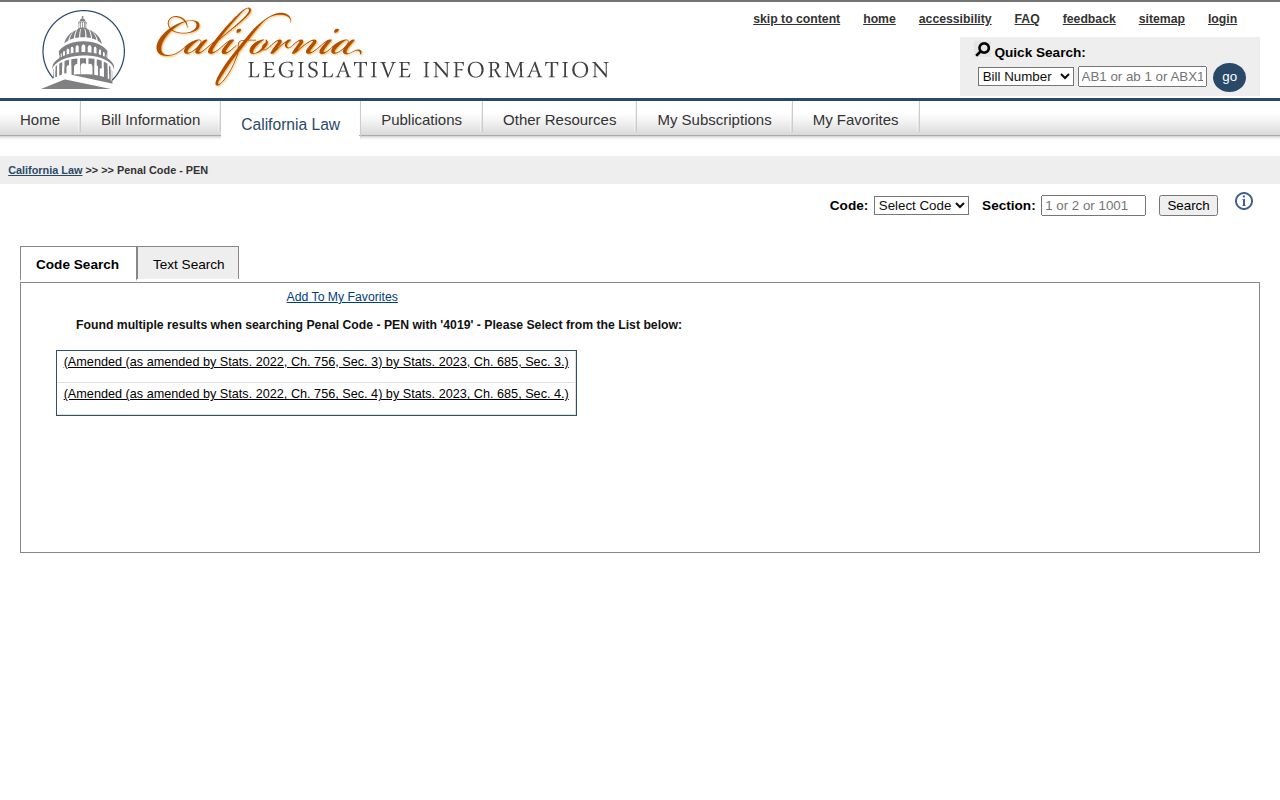
This statute is the county-jail conduct-credit source for many local custody calculations.
Why Release Dates Change
Release dates are moving records. A change can come from inside the jail or prison, from court, from another agency, or from a supervision decision. Humboldt users should treat a projected date as a planning clue and keep checking the official source as the date gets close.
| Change factor | Effect on release timing |
|---|---|
| Credits corrected or lost | Can move a projected date earlier or later depending on earned, denied, restored, or recalculated credits. |
| Court order or amended sentence | Can change the commitment, custody credits, or release authority. |
| New warrant, hold, or detainer | Can prevent community release even when one custody sentence ends. |
| Parole hearing result | A grant, denial, waiver, postponement, or stipulation can alter a CDCR parole path. |
| Transfer to another system | HCCF, CDCR, BOP, ICE, or another agency may control the next custody step. |
HCCF Timing Is Practical
For the Humboldt County jail, public reports are better at confirming actual releases than predicting future releases. The Sheriff's release timing page says recognizance releases occur after booking completion when safe, court releases depend on paperwork reaching and being processed by the jail, and served-sentence releases are generally between 7 a.m. and 9 a.m. If the user is asking whether someone has already left HCCF, use the 24-Hour Release List or the three-day PDF check.
Morning PDF timing also means a release can happen before the public report appears. If a person is expected to leave after a court hearing, VINE or direct agency contact may update before the next dated Released PDF is posted. Once the report appears, use its release date/time and release type as the local proof of the HCCF custody event.
Pretrial Detainees Have No Fixed Date
A pretrial detainee at HCCF is different from a sentenced person with a calculated end date. Pretrial release can depend on bail, own recognizance release, court order, holds, medical transfer, paperwork timing, or a statutory custody release. That is why the Humboldt release report may later show release type such as bail bond, O.R. misdemeanor, transfer to medical facility, or Penal Code 849(b)(2), but the public report does not forecast those events in advance.
For a pending case, the most reliable release-date clues often come from court calendars, hearing results, bail status, attorney information, and jail processing. If court paperwork has been issued but not processed by the jail, the person may be legally on a release path while still physically in custody. Humboldt's release timing page specifically warns that court releases can be delayed by court volume or difficulty getting paperwork from court to jail.
Release Date Is Not Supervision End
A release date answers when one custody event ends. It does not always answer whether parole, probation, PRCS, a court appearance, registration duty, or another agency hold remains. CDCR release may lead to DAPO parole through the Eureka parole unit. A Humboldt Superior Court sentence may include county probation. A BOP release may be followed by federal supervision. Use Parole & Probation when the next question is who supervises the person after release.
The final confirmation should come after the date passes. For HCCF, that means checking the Released PDF that covers the actual window and reading the release date/time. For CDCR, it may mean checking CIRIS, parole-office assignment, BPH results, or CDCR records. For court-controlled changes, it means checking the court file. A projected date is useful planning information, but the actual release record is the proof that custody changed.
That distinction is especially important for Humboldt because the public county jail source is retrospective: it documents the release after the jail system has completed the event.
For a state parole case, the date field may mark eligibility for consideration rather than physical release. A BPH grant, denial, waiver, postponement, or stipulation can affect the path, and DAPO may become the next agency after release. For a local probation case, Humboldt Superior Court and County Probation define the terms that survive the jail release date.